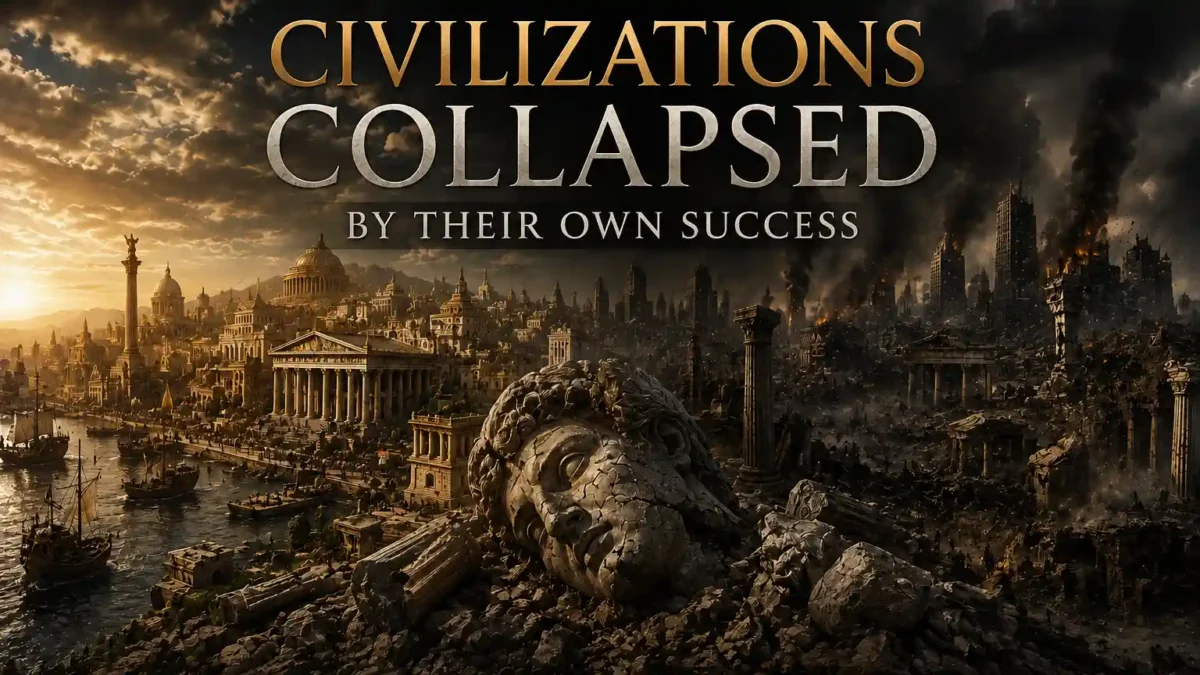
The Civilizations That Were Too Good at What They Did
There’s a pattern hiding inside the ruins of the ancient world, and it’s not the one you learned in school.
The common story goes like this: great civilization rises, gets too ambitious, overreaches, and falls. Hubris as historical law. But spend time with the actual archaeology, the soil cores from Tell-Leilan, the LiDAR maps of Greater Angkor, the Linear B tablets from Pylos and a stranger, more unsettling picture emerges. The civilizations that collapsed weren’t the incompetent ones. They were, in almost every case, the ones that had gotten extraordinarily good at something. Not just competent. Optimized.
Optimization is how civilizations are built. It’s also, quietly, how they’re broken.
The Feedback Loop Nobody Talks About
A society develops a technology that dramatically increases its productive capacity — food, water, military force, administrative control. That success enables population growth, because why wouldn’t it, right? More people can be fed. More territory can be held. The infrastructure scales up to match. Then something subtle happens: the old ways of doing things, the redundant, inefficient, flexible ways get abandoned. Why maintain backup systems when the primary system works so well? Why diversify crops when your monoculture yields are extraordinary? Why keep generalist skills when specialists are so much more productive?
The slack disappears. The margin closes. And the system, built to handle expected variance, now has no room for unexpected variance. Then the unexpected arrives.
This isn’t a story about stupidity or greed. The people making these decisions were often doing the rational thing given what they knew. The problem is that optimization and resilience are fundamentally in tension. Every efficiency gain tends to eliminate a redundancy. And redundancies, which look like waste in good times, are what keep a system alive when conditions shift.
Angkor: When the Infrastructure Becomes the Civilization
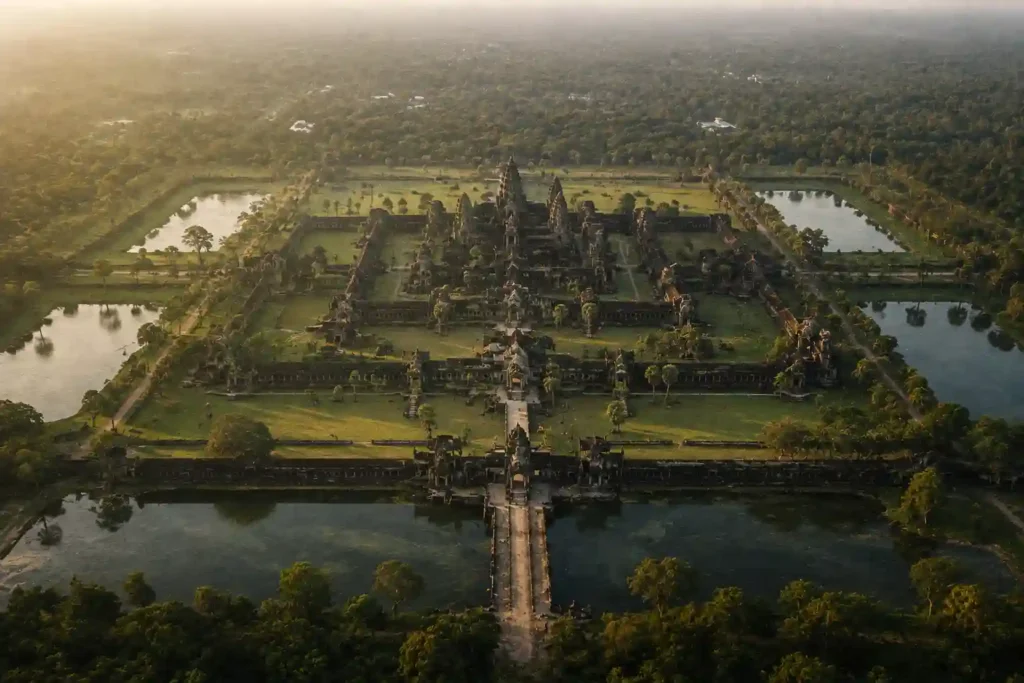
Greater Angkor, at its 12th-century peak, was probably the largest city on Earth, somewhere around 1,000 square kilometers of urban footprint, supporting a population that may have exceeded 750,000. Contemporary London had perhaps 50,000 people. The Khmer empire didn’t build a city and then build water management to support it. The water management was the city. The baray reservoirs, the canal networks, the precisely engineered distribution channels weren’t amenities. They were the reason the population density was possible in a monsoon-dependent environment where rainfall came in violent, irregular surges.
LiDAR surveys completed after 2012 revealed what the jungle had hidden for centuries: the full, extraordinary extent of the system, and also its history of ad hoc modification. As Angkor grew, the network was expanded and patched — new channels, new connections, accumulated compromises. Sediment load increased. Flood vulnerability increased. The system engineered for a certain scale was being asked to perform at a scale it hadn’t been designed for, and the maintenance demands grew faster than the administrative capacity to meet them.
When a series of extreme monsoon events and droughts hit in the 14th and 15th centuries, they didn’t overwhelm a healthy system. They overwhelmed a system already operating past its tolerances, maintained by a civilization that had grown so large it couldn’t function without the water infrastructure and couldn’t adequately maintain the water infrastructure because of its size. The city wasn’t abandoned because something went wrong. It was abandoned because too much had gone right for too long.
Enjoying this?
Get more deep dives like this one, straight to your inbox.
Tiwanaku’s Perfect Farm
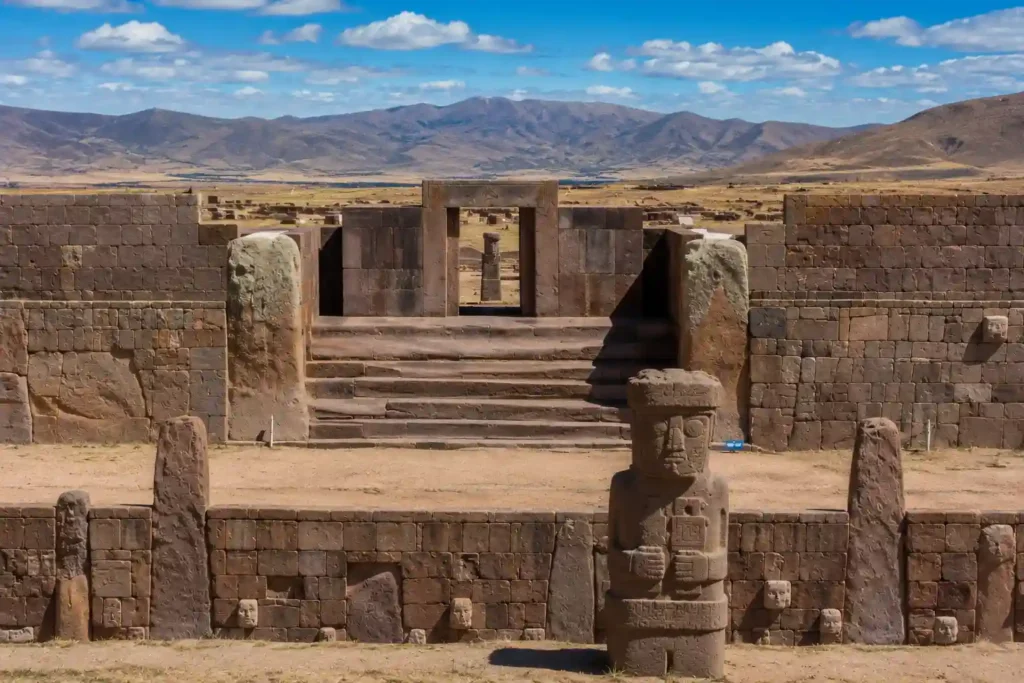
Around Lake Titicaca, between roughly 500 and 1000 CE, the Tiwanaku civilization built what might be the most elegant agricultural system ever devised. The suk’a kollu — raised planting fields separated by water-filled canals. Sounds simple until you understand what it did: the canals absorbed solar heat during the day and released it at night, moderating the killing frosts that made high-altitude farming so precarious. Aquatic plants decomposed in the channels and were periodically dredged onto the fields as fertilizer. The system recycled its own nutrients, buffered against temperature extremes, and produced yields that modern experimental reconstructions have matched at 8 to 10 tons of potatoes per hectare, competitive with contemporary Andean farming without synthetic inputs.
It was almost absurdly good. And the civilization built itself around that goodness — population density, settlement patterns, political organization all premised on the system continuing to function. When a prolonged drought hit around 1000 CE, there was no fallback agriculture to revert to, no reservoir of generalist knowledge about farming marginal land without the canals. The raised fields required water in the channels to work. Without water, they were just mounds of dirt. The Tiwanaku didn’t fail because they were bad farmers. They failed because they were such extraordinary farmers that they’d forgotten how to be ordinary ones.
The Writing System That Vanished With Its Civilization
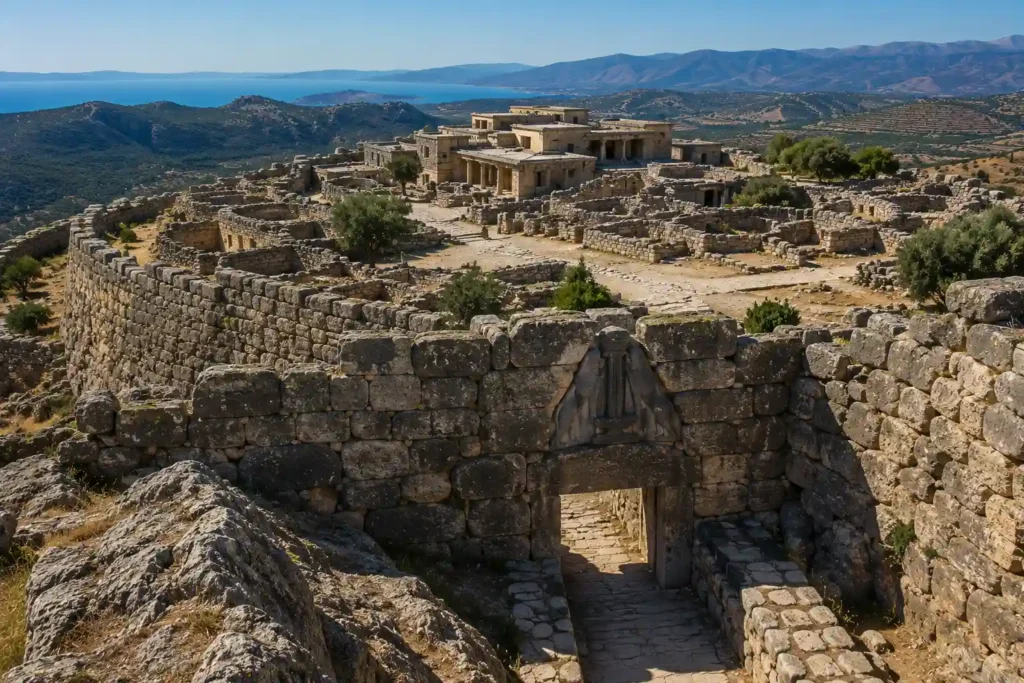
Linear B, the script used in Mycenaean Greece is one of the stranger artifacts in the archaeology of collapse. It wasn’t used for literature, religion, or correspondence. Almost exclusively, it tracked things: rations allocated to individual workers, bronze distributed to smiths in precisely measured lots, flocks recorded by the name of the shepherd responsible for them. It was administrative software running on clay tablets, managing a palace command economy of remarkable granularity.
That level of control was genuinely impressive. Mycenaean Greece around 1300 BCE was one of the most administratively sophisticated societies on Earth. It was also one of the most brittle because Linear B had no function outside the palace system. There were no merchants using it, no religious institutions, no civic organizations. The script and the civilization were so completely co-evolved that when the palaces burned around 1200 BCE, literacy itself became pointless. Within a generation or two, it was gone. Greece went dark, pre-literate, village-scale for roughly 400 years. That’s not a pause or a setback. That’s a system returning to its baseline once the technological superstructure was removed.
There was nothing underneath, because the palace economy had never needed anything underneath.
When Iron Made Bronze a Liability
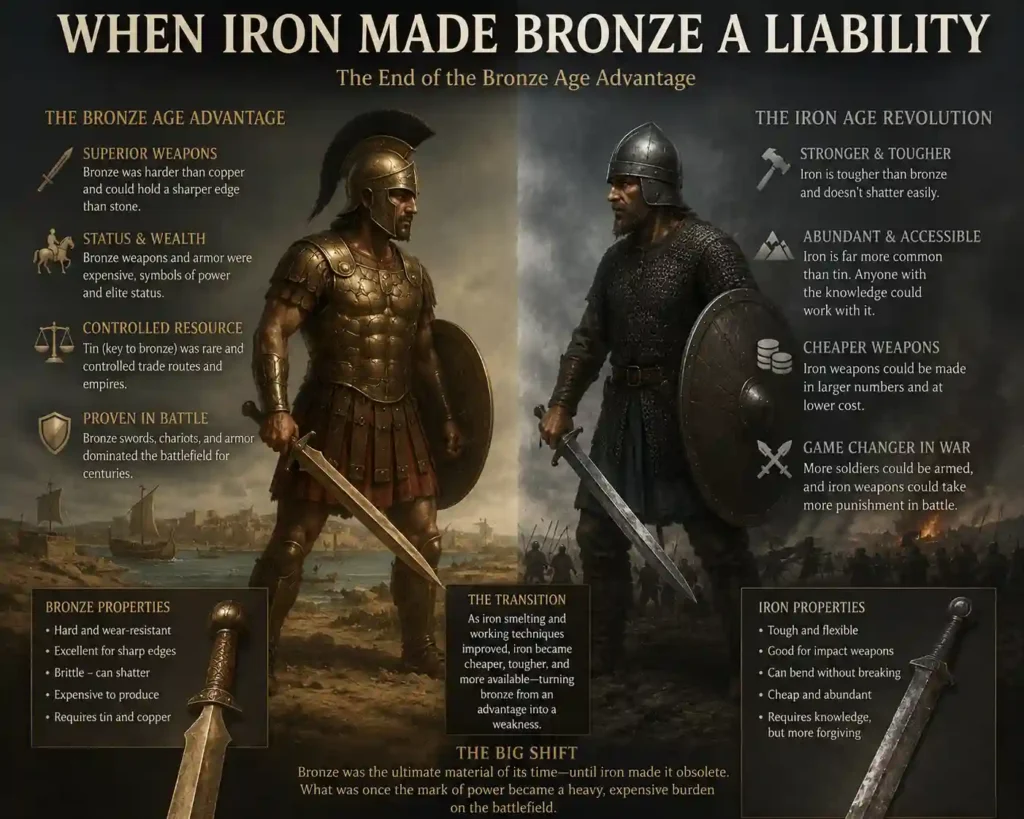
Part of what destroyed those Mycenaean palaces and the broader network of Bronze Age palace economies was a disruption that illustrates the optimization trap at its sharpest. Bronze required tin, and tin was extraordinarily rare. The eastern Mediterranean’s civilizations had spent centuries perfecting the logistics of moving it: from Cornwall, from Afghanistan, across thousands of miles of land and sea routes, intermediated by specialized merchant networks. The Uluburun shipwreck, dated to around 1300 BCE, carried 10 tons of copper and exactly 1 ton of tin — the precise 10:1 ratio for making bronze, clearly a state-level procurement shipment.
That supply chain was a marvel. It was also a single point of failure strung across thousands of miles with no local substitute anywhere along the eastern Mediterranean coast.
When iron metallurgy began spreading around 1200 BCE, it didn’t just offer an alternative metal. Iron ore was abundant almost everywhere. Any reasonably capable smith could work with locally available material. The palace economies had spent generations optimizing military power around their control of bronze, the monopoly on weapons was partly what made the palace system politically stable. Iron dissolved that monopoly. Groups that had previously been militarily dependent on palace-controlled bronze could now arm themselves. The civilizations most invested in bronze, most thoroughly optimized for it, were the most exposed when that advantage evaporated.
The Sea Peoples and related disruptions that followed weren’t simply an invasion. They were, in part, the consequence of a technology gap closing. When the trade networks broke and bronze production stopped, not slowed, stopped, the most militarily advanced civilizations on Earth found themselves unable to re-equip their armies. They were defeated not by a superior enemy but by a supply chain collapse that their optimization had made catastrophic.
The Technology That Was Too Durable
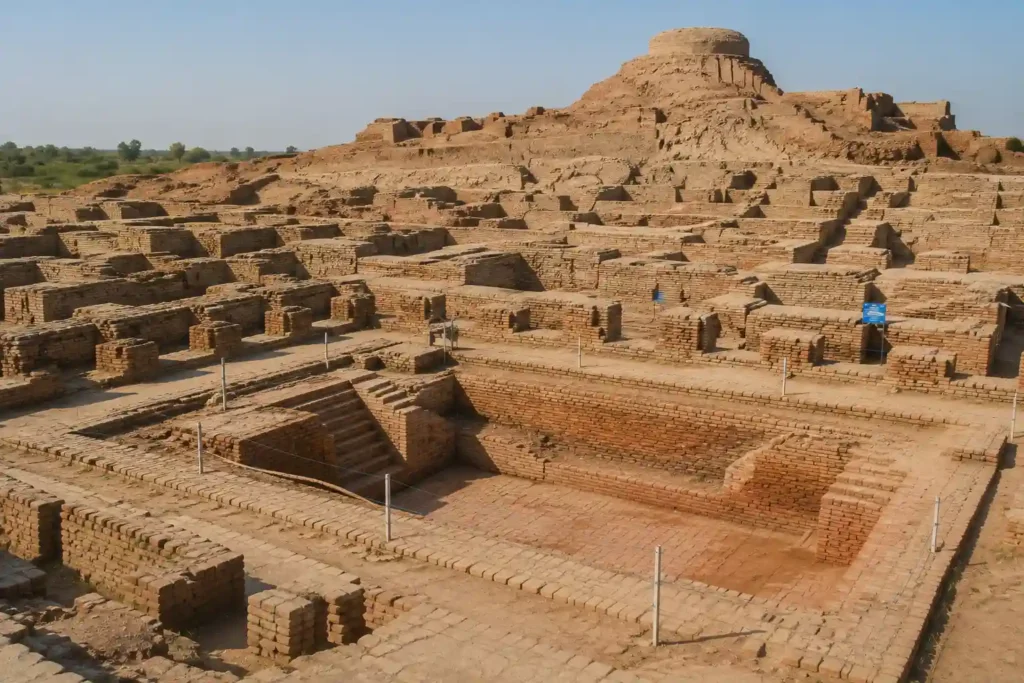
The Harappan paradox deserves a moment of genuine astonishment before the analysis. Mohenjo-daro, at its height around 2500 BCE, had covered brick drains connecting nearly every house to a centralized sewage system — infrastructure that didn’t exist in contemporary Egypt or Mesopotamia, and that exceeded the urban sanitation of many Indian cities as late as the 1940s. A four-thousand-year gap between an ancient city and the cities that replaced it, in the same region, on the same subcontinent. The engineering was that far ahead of its time.
It was also engineering that required centralized administrative coherence to maintain. The drains needed cleaning, the bricks needed replacing, the system needed coordination across an entire city. When the Indus Valley Civilization collapsed, and the honest answer is that nobody is entirely sure why, which is itself telling about how completely the administrative knowledge was lost, the infrastructure didn’t fail first. The administration did. And without the coordinating apparatus, the most sophisticated urban sanitation system in the ancient world became unworkable almost immediately. The drains silted up. The connections broke. Four thousand years of potential progress, foreclosed within a generation, because the achievement and the administration that sustained it were inseparable.
The Plow That Turned Drought Into Catastrophe
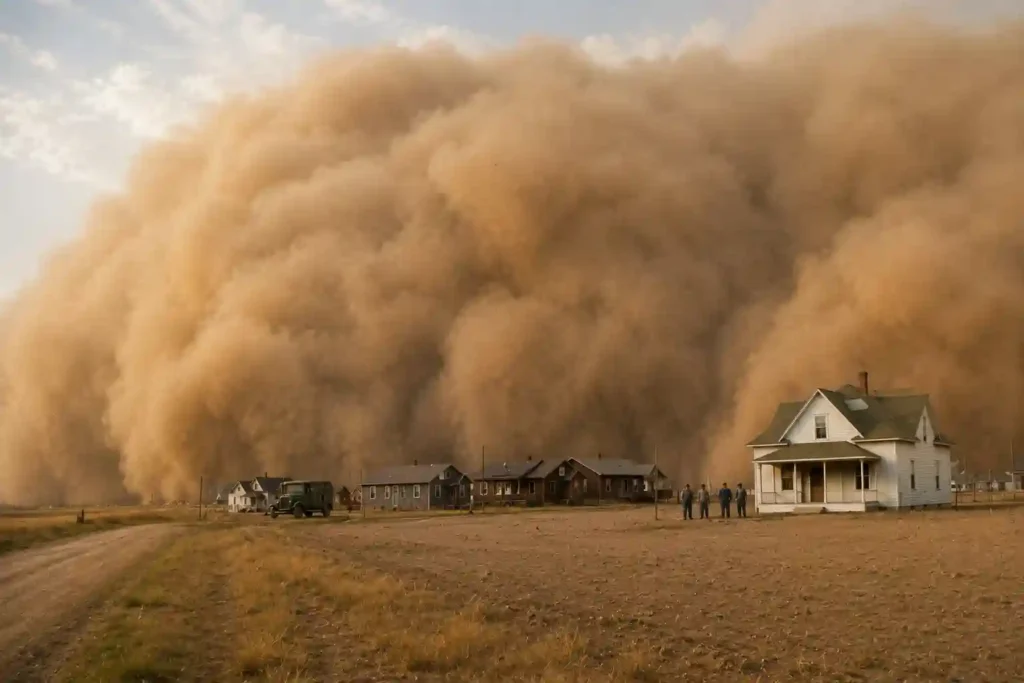
The Dust Bowl is close enough in time that we have photographs, congressional testimony, oral histories. It doesn’t feel like ancient history. But the mechanism is identical to everything above, and it’s worth naming plainly.
The steel moldboard plow, introduced to the Great Plains in the 1830s and 1840s, solved a real problem: the deep-rooted native sod that made the land nearly impossible to farm at scale. Within decades, tens of millions of acres of grass that had held the topsoil through millennia of drought cycles were replaced with shallow-rooted wheat. The yields were extraordinary. The Plains became the breadbasket of the continent. Population surged into the region.
The native grass was the redundancy. It didn’t produce food, but it performed a function, soil retention through dry years, that wheat couldn’t replicate. When the 1930s drought arrived, not meaningfully different in severity from droughts the Plains had weathered many times before, there was nothing holding the soil. Around 100 million acres stripped. Seventy-five percent of topsoil lost in some areas within a single decade. About 3.5 million people displaced, the largest internal migration in American history to that point. The plow didn’t cause the drought. It converted a manageable drought into a near-civilizational event by eliminating the biological slack that had always absorbed it.
The United States survived through federal intervention and eventually adaptive policy, a near-miss, not a full collapse, and worth noting because the response demonstrated that adaptive capacity hadn’t entirely vanished. But the mechanism was identical to Tiwanaku, to Angkor, to the Bronze Age tin network. Optimization removed the buffer. The variance arrived anyway.
What the Ruins Are Actually Saying
The cautionary reading of all this — don’t get too good at one thing — is true but incomplete. These societies weren’t making obvious mistakes. Harappan engineers weren’t being reckless when they built covered drains. Tiwanaku farmers weren’t being naive when they expanded the raised fields. Mycenaean palace administrators weren’t being shortsighted when they developed exquisitely precise accounting systems. They were solving real problems, extremely well, in ways that made their civilizations larger and more productive and more capable than anything around them.
Liked where this went?
Subscribe and never miss the next rabbit hole.
The problem isn’t optimization. The problem is what optimization does to the system around it over time, quietly, incrementally, in ways that are nearly invisible until the variance arrives. Success encourages doubling down. Doubling down increases dependency. Dependency eliminates the slack that would have allowed adaptation. And then the drought comes, or the trade route breaks, or the new metal arrives, and there’s no margin left to absorb it.

The Rapa Nui story, worth noting, is currently being revised in exactly this direction. The classic ecocide narrative — deforestation, population crash, self-destruction — is being complicated by a 2024 Science Advances study showing extensive rock garden agriculture across the island, evidence of adaptive food production rather than a society in freefall. The real collapse on Rapa Nui may owe far more to European contact and disease than to internal overreach. The field is genuinely divided on this, and anyone telling you the Easter Island story is settled probably read it in a book published before 2020.
Which is itself a small illustration of the larger point: the story of why civilizations fall is almost always more interesting, and more honest, than the version that got popular.
The ruins aren’t monuments to failure. They’re monuments to extraordinary success — at a specific thing, in a specific set of conditions, for as long as those conditions held. Mohenjo-daro’s drains worked perfectly until the moment they didn’t. Angkor’s reservoirs were an engineering triumph until the monsoons stopped cooperating. The Mycenaean palace economy was a model of administrative precision until the palaces burned and there was no one left who saw any reason to write things down.
The question worth sitting with isn’t what did they do wrong. It’s what did they stop being able to do — and whether anyone noticed the slack was gone before it was too late to matter.

Leave a Reply