The Government Paid to Make a Chocolate Bar Taste Terrible
Somewhere in Natick, Massachusetts, a team of researchers is currently perfecting a pizza that will stay shelf-stable for three years without refrigeration. They’re also working on high-protein bars engineered to survive desert heat without crumbling. When they crack both problems, and they will, the results will eventually appear on a grocery shelf near you. Not because a food company decided to license the technology. Because federal policy requires it.
This isn’t a story about the past. The pipeline from military laboratory to supermarket aisle has been running for roughly eighty years, and it’s still open.
What we found was that most writing on this subject turns it into a trivia game: M&Ms were made for soldiers, SPAM went to the Pacific theater, the microwave oven was born when a Raytheon engineer’s candy bar melted in front of radar equipment. All true, all interesting, all missing the actual story. Because the question worth asking isn’t which foods came from the military — it’s how the transfer keeps happening, who captures the value when it does, and what it means that the food system built to keep soldiers alive in the field now shapes what everyone eats every day.
Journalist Anastacia Marx de Salcedo, who wrote the definitive book on this subject, estimated that if you cleared every military-influenced product from grocery store shelves, you’d be looking at a store that’s half empty. That figure is her framing rather than an audited statistic, but it lands for a reason: once you start looking for the through-line, it’s everywhere.
The Bitter Bar, and What It Reveals
Start with the strangest story in this whole history, because it opens a door that the trivia version never does.
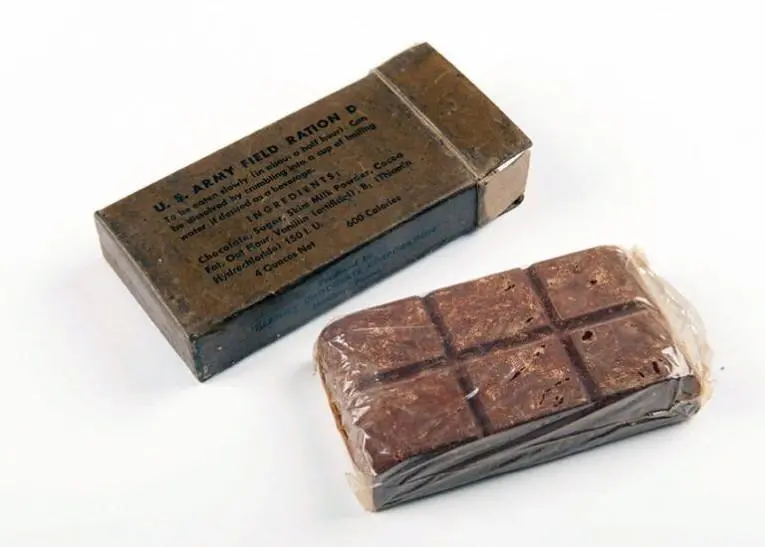
In the late 1930s, the U.S. Army sat down with Hershey’s food scientists and gave them an unusual assignment. They needed an emergency ration bar — calorie-dense, fortified, durable for soldiers to carry as a last resort. And they had one specific requirement that no commercial food company had ever faced before: it needed to taste bad. Not just acceptable. Actively unpleasant. The Logan D ration bar was deliberately engineered to be bitter, because if it tasted good, soldiers would eat it recreationally and destroy the emergency supply.
Think about what that represents. Every food company in history has been trying to make food more appealing. The entire science of flavor engineering, the salt-fat-sugar optimization that drives product development at every major food corporation exists to make you want more. The Army inverted the entire logic of commercial food: here is a product we need you to not want.
That bar, and the partnership that created it, contains the seed of everything that followed. The Army needed food science it didn’t have. Hershey had it. A contractual relationship was formed, and military nutrition research and industrial food production became permanently entangled. The Logan D ration itself never made it to grocery shelves, that was the point. But the relationship it represented would eventually reshape the entire center aisle of the American supermarket.
The Pipeline, and How It Works
The transfer of military food technology to civilian markets is not accidental. It’s structural.
The U.S. military is subject to policy requiring it to share successful research with the commercial sector, a feature of national readiness doctrine that ensures wartime food science investment doesn’t disappear into classified archives. The specific legal and regulatory architecture behind this is worth tracing (the Stevenson-Wydler Technology Innovation Act of 1980 codified federal technology transfer obligations more broadly, and DoD food programs operate within that framework), but the practical effect is straightforward: when Natick cracks the three-year pizza problem, the science goes public.
Enjoying this?
Get more deep dives like this one, straight to your inbox.
What this means is that the corporations best positioned to commercialize new military food science are the ones that already hold the military contracts. ConAgra, General Mills, Hershey, Hormel, Mars, Nabisco, Tyson, Unilever — these companies manufactured C-rations and K-rations. They already knew the science because they helped develop it, using taxpayer-funded military contracts. When the technology transferred to the civilian market, they had the manufacturing infrastructure, the distribution relationships, and the scientific head start to capture the commercial upside first.
Taxpayers funded the primary R&D. The same companies that held the wartime contracts took the profits. This is not an accident or a conspiracy, it’s just how the pipeline was designed to work. The military needed reliable industrial partners who could scale production fast. Those partners got an education in food science that no civilian competitor could match.
The McNugget’s Secret Lineage
The most commercially consequential downstream product of military food science rarely appears in any article on this subject. It’s not freeze-dried coffee or instant mashed potatoes. It’s the Chicken McNugget.
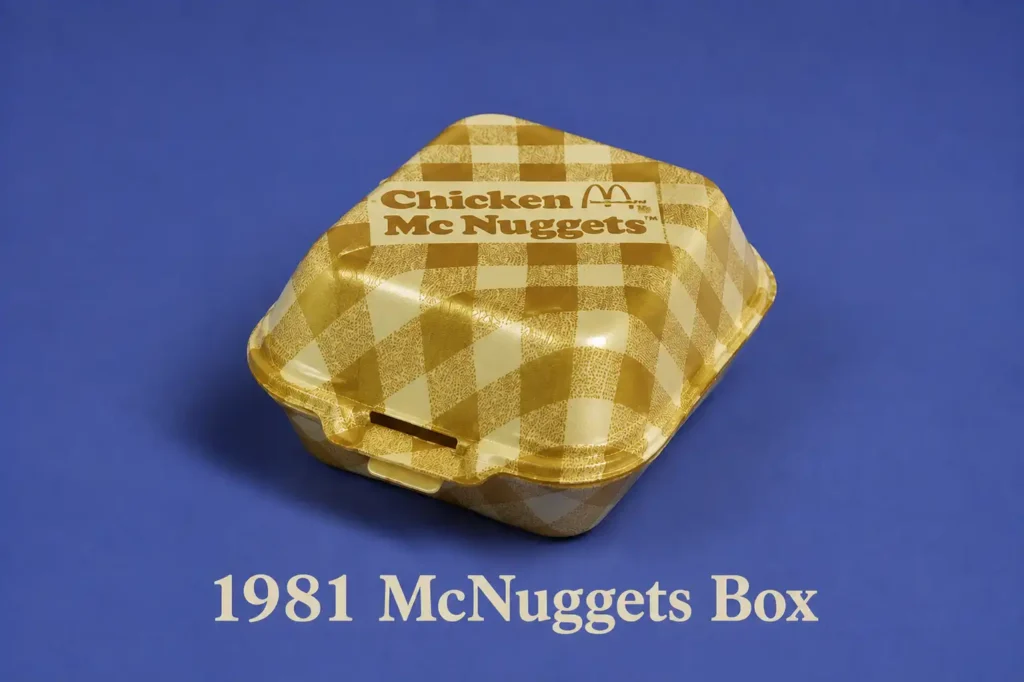
In 1981, McDonald’s launched the McNugget, and it became one of the most recognizable fast food items in history. What the company didn’t advertise was that the processing technique making it possible — taking chicken pieces, homogenizing them, and reforming them into a uniform shape came directly out of military research into restructured meat. The same logic underlies the McRib: the “rib” shape is a fiction made possible only because the pork has been completely broken down and remolded. Both products trace their structural core to the same military food science problem: how do you take lower-value cuts of meat, make them shelf-stable, portable, and consistent in texture, and get soldiers to eat them without complaint?
The answer the military developed was essentially an industrial erasure of what meat actually is. Grind it, bind it, reform it. The resulting product is structurally identical regardless of which animal parts went in. For soldiers, this solved a logistics problem. For McDonald’s, it solved a cost problem. The chicken that couldn’t be sold as breast meat could now be sold as a McNugget. The pork trim that had no obvious retail application became a McRib.
This is the part of the story that the “isn’t it cool that M&Ms were made for soldiers” version never gets to: military food science wasn’t just about inventing new products. It was about figuring out how to extract maximum caloric value from minimum raw material, make the result stable over long timelines, and engineer the texture and flavor to overcome resistance. Every one of those goals translated directly into commercial food production, not as a happy side effect, but as the exact same problem framed slightly differently.
The Infrastructure Nobody Talks About
There’s another transfer that gets almost no coverage: not the science, but the physical infrastructure.
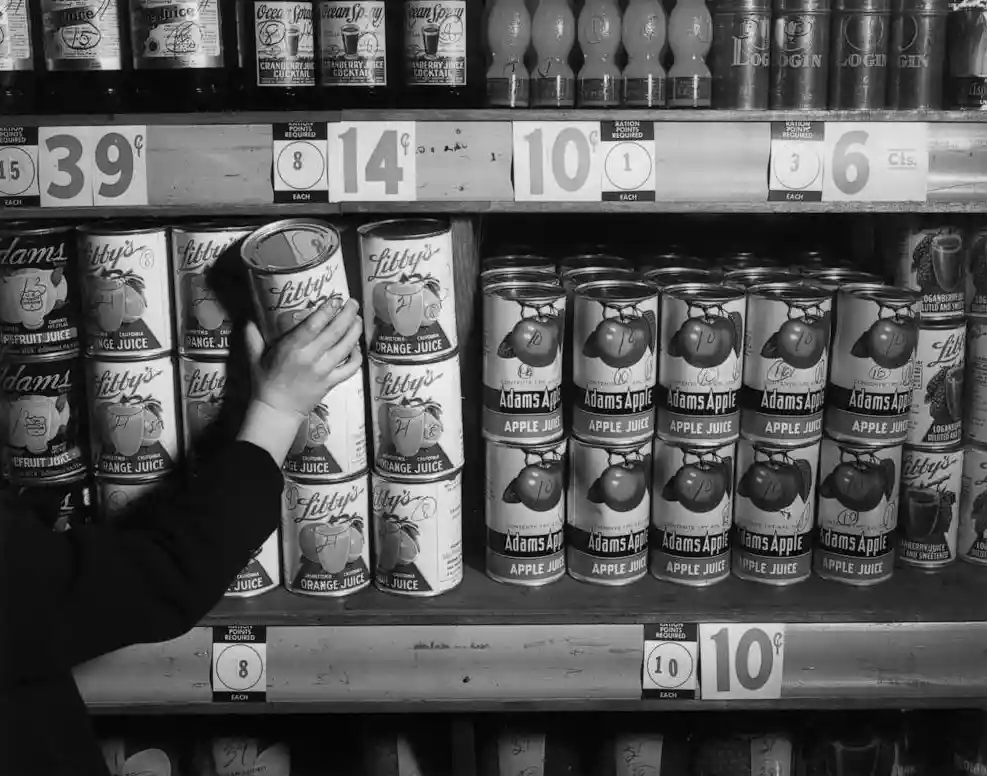
Millions of service members came home from WWII already conditioned to frozen and shelf-stable food as normal. They’d spent years eating it. They weren’t suspicious of it the way their parents might have been. They were, without anyone having planned it this way, a primed consumer base for exactly the products the frozen food industry was preparing to sell.
But more than consumer attitudes transferred. The military had built an enormous cold-chain infrastructure — refrigerated storage facilities, refrigerated transport ships to move food to troops across multiple ocean theaters. That infrastructure didn’t vanish in 1945. It was converted to civilian use, and it became the logistical backbone of the American frozen food industry. The supply chain that eventually made it possible to deliver tens of millions of frozen turkeys to American tables every Thanksgiving wasn’t built from scratch by food companies. It was largely inherited from a wartime logistics system that had already solved the hard problems.
Frozen orange juice concentrate tells a compressed version of this story. The technology was developed using military-funded science. Florida Foods Corp. commercialized it, rebranded as Minute Maid, and created one of the first major products in the frozen grocery aisle. The science, the infrastructure, and the consumer conditioning all arrived simultaneously — because they all came from the same source.
Modified Atmosphere Packaging, the technology that adjusts the gas balance inside food packaging to dramatically slow oxidation, has a similar trajectory. It now governs the shelf life of an enormous share of what’s in any grocery store — the bagged salads, the pre-cut fruit, the deli meats that stay fresh far longer than they should. Its development runs through military food preservation research. It’s probably more pervasive than any single food product on this list, and it gets almost no attention in the standard telling.
The Thing Nobody Wants to Say Out Loud
Here’s where the story gets uncomfortable.
The properties that made military ration food work calorie density, high sodium, extended shelf life, engineered palatability are exactly the properties now linked to the modern ultra-processed food crisis. The science of making food stable, portable, and appealing enough that soldiers would actually eat it under stress turned out to be extraordinarily good at making civilians eat more than they should under no stress at all.
This isn’t a simple causal argument. The rise of ultra-processed food in the American diet has multiple drivers — agricultural policy, urban sprawl, marketing, the collapse of household cooking time. But one of those drivers is that the food science infrastructure built to solve a military problem was handed to corporations whose entire incentive was to apply it as aggressively as possible to civilian consumption. The salt loads that kept soldiers from dehydrating in the Pacific became the salt loads that make potato chips impossible to stop eating. The calorie density engineered to sustain men under extreme physical exertion got applied to food eaten by people sitting at desks.
Researchers like Carlos Monteiro, whose NOVA classification system categorizes foods by degree of industrial processing, have documented the health consequences with increasing precision. Ultra-processed foods now account for the majority of calories in the average American diet, and their association with obesity, cardiovascular disease, and metabolic disorders is well-established in the epidemiological literature. Chris van Tulleken’s Ultra-Processed People (2023) makes the accessible version of this case in detail. Neither traces the origin story back to military procurement, but the line runs there.
The food companies didn’t set out to make Americans sick. They set out to apply the most sophisticated food science available, science they’d developed in partnership with the military, using public money to products optimized for repeat purchase. The outcome was predictable in retrospect.
The Pipeline Is Still Open
Back to Natick.
Liked where this went?
Subscribe and never miss the next rabbit hole.
The researchers there working on three-year shelf-stable pizza aren’t doing it because they think civilians want three-year pizza. They’re doing it because soldiers need food that survives forward deployment in extreme conditions. But the science required to make a pizza stay safe and palatable for three years without refrigeration — controlling water activity, managing microbial growth, engineering the crust texture to not turn to cardboard is science with obvious civilian applications. It will transfer. It’s designed to.
The same goes for the high-protein ration bars currently in development: engineered to survive heat, humidity, and the compression of a packed rucksack without crumbling, with protein profiles calibrated to sustain soldiers under physical load. When those bars work well enough, the underlying technology joins the same queue that brought us instant mashed potatoes, shelf-stable bread developed from Kansas State University’s work on fatty acids and bacterial enzymes, and the restructured meat science that became the McNugget.
Shelf-stable bread, incidentally, is worth a moment’s pause. The military contracted Kansas State University in the 1950s to solve the stale-bread problem. The solution involved fatty acids and bacterial enzymes, chemistry that now quietly underpins the extended shelf life of almost every commercial loaf in the supermarket. Nobody buying sandwich bread thinks about military procurement contracts. But the reason that bread sits on the shelf for two weeks without going stale is a direct line from that research.
This is what Marx de Salcedo’s half-empty-shelves estimate is actually pointing at. It’s not that the military invented a handful of fun products that happened to go mainstream. It’s that military food science, transferred through a legally mandated pipeline to corporations already positioned to commercialize it, quietly became the foundation of how industrially produced food works. The Natick Soldier Systems Center is still adding to that foundation right now.
The Logan D ration was designed to be eaten only in desperation — bitter by requirement, functional by necessity, pleasurable by nobody’s intention. The corporate food industry took the same underlying science, removed the bitterness, optimized relentlessly for palatability, and built a multi-trillion dollar industry on the result. Whether that’s a triumph of innovation or a slow-motion public health problem depends on where you’re standing in the grocery aisle, and possibly on how carefully you read the ingredients label on whatever you’re holding.

Leave a Reply