
The Diamond Is a Lie You Agreed To (And So Is Almost Everything Else Worth Anything)

There’s a pebble at the bottom of the Everest summit that is chemically identical to a pebble in the parking lot of a strip mall in Ohio. Same mineral composition, same weight, same hardness. One is worth nothing. The other is nearly impossible to price — not because no one wants it, but because the people who understand its value refuse to participate in the pricing conversation. The moment you ask “how much?” you’ve already missed the point.
The paradox that objects that are physically identical but separated by an almost infinite gulf of value is the cleanest way to start pulling on the thread of what value actually is. Because once you start pulling, the whole sweater comes apart in a way that’s genuinely unsettling, and also kind of wonderful.
The Lie That Rewired a Civilization
Let’s start with the most dramatic case study in the history of manufactured value, because once you’ve seen it, you can’t unsee the same mechanics running everywhere else.
In 1938, only about 10% of engagement rings contained diamonds. There was no universal marriage jewelry norm, betrothal rings featured colored gems, pearls, small clusters of stones. Diamonds weren’t special. They were just another gemstone.
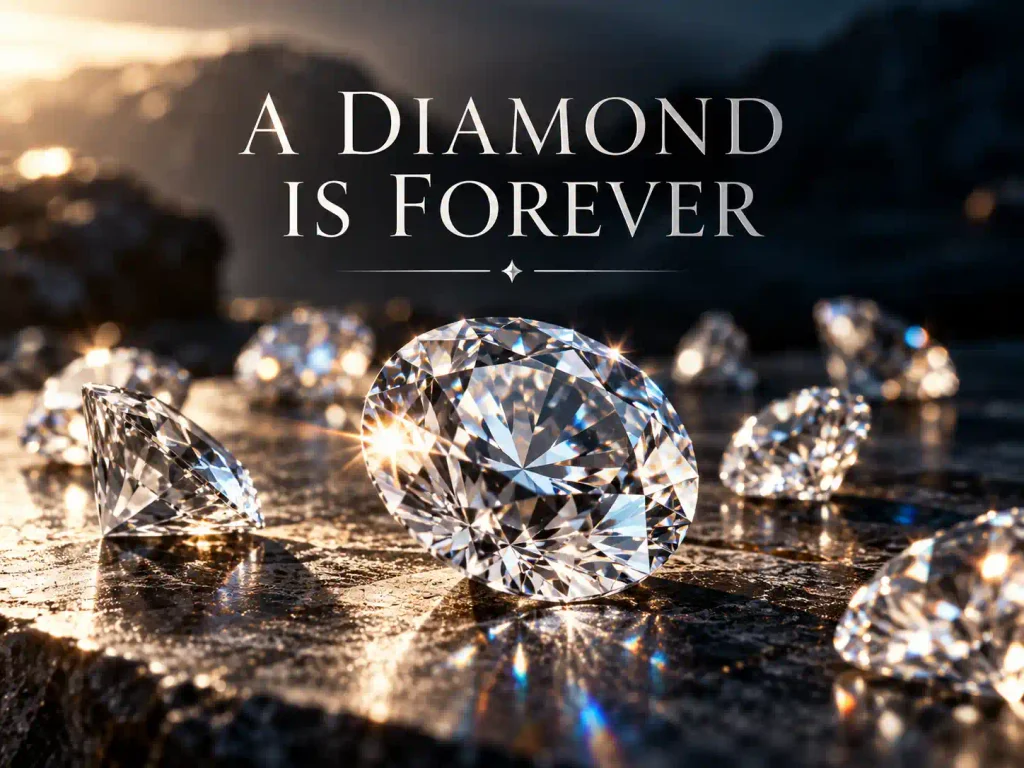
Then De Beers hired a Philadelphia advertising agency called N.W. Ayer and launched what became one of the most consequential marketing campaigns in modern history. A copywriter named Frances Gerety wrote the slogan “A Diamond Is Forever”, coined around 1947 or 1948 and De Beers began systematically weaving diamonds into the cultural fabric of romantic commitment.
“A Diamond Is Forever”
By the late 1990s, more than 80% of American brides received diamond engagement rings. That’s not a gradual cultural drift. That’s the wholesale manufacture of a civilization’s most intimate ritual, accomplished within two generations, by a marketing campaign.
Here’s the part that doesn’t get told enough: the slogan was also quietly engineered to destroy the diamond resale market. “A Diamond Is Forever” framed the stone as eternal, emotionally non-transferable, something you simply do not sell. This was genius on two levels. It inflated sentimental attachment while simultaneously suppressing price discovery in secondary markets.
Diamonds aren’t actually scarce in the way that rare earth metals are. De Beers spent most of the twentieth century controlling the vast majority of the world’s rough diamond supply, stockpiling excess stones in their vaults to keep prices artificially elevated. The marketing arm locked consumers in emotionally; the supply arm locked prices up structurally. Both mechanisms worked together like a vise.
The company was so aggressive about this that De Beers executives literally could not enter the United States, their largest single market, where more than half the world’s diamonds are purchased, for decades, because the US Justice Department considered them a criminal cartel. When De Beers finally pleaded guilty to conspiring to fix the price of industrial diamonds, the fine was $10 million. In an industry generating tens of billions annually, this was essentially a rounding error. The math tells you everything about the economics of engineered monopoly.
So that’s the first revelation: some of the most valuable things in the world are not intrinsically valuable. They are agreed to be valuable because enough people accepted a story about them, and then the infrastructure that could challenge the story was quietly dismantled.
The diamond is not an anomaly, it is the template.
Enjoying this?
Get more deep dives like this one, straight to your inbox.
Your Brain Is Running 50,000-Year-Old Software
The deeper question is: why does the template work so reliably?
The answer is that the human brain was not designed for the modern economy. It was designed for an East African savanna roughly 50,000 years ago, and it is running the same basic software today. That software has a strong and specific relationship with scarcity, because in the ancestral environment, scarcity meant survival threat. Food was finite. Water sources could dry up. These were not abstract economic concerns; they were life and death. So the brain evolved to treat scarce things as high-priority objects of desire, essentially automatically.
Kahneman and Tversky’s prospect theory work quantified one dimension of this with unusual precision. Losses are weighted approximately 2.25 times more heavily than equivalent gains meaning the pain of losing $100 is measurably more powerful than the pleasure of finding $100. Subsequent meta-analyses have produced a range of coefficients, and the effect varies across cultures, so the shorthand “losses feel twice as bad as gains feel good” is actually a slight understatement of the original finding while potentially overstating its universality. What remains robust is the direction: losses hit harder than equivalent gains, reliably and across many contexts.
Losses are weighted approximately 2.25 times more heavily than equivalent gains meaning the pain of losing $100 is measurably more powerful than the pleasure of finding $100.
What this means practically is that every “only 3 left in stock” warning, every countdown timer, every limited-edition drop is not a marketing gimmick, it is a precision instrument aimed at a specific cognitive vulnerability. The scarcity is often manufactured. The fear response it triggers is ancient and real.
There’s a cookie jar experiment that makes this uncomfortably concrete. Participants were given jars containing either two or ten cookies. Then, eight cookies were removed from the ten-cookie group and added to the two-cookie group. The people left with two rated their cookies as significantly more valuable than the people who now had ten. The same physical cookie, judged entirely differently based not on what it was but on the direction of change. Counterintuitively, the group that went from two to ten valued their cookies less than almost anyone else. Abundance, even sudden abundance, deflates perceived value. The brain isn’t tracking what you have — it’s tracking trajectory.
The people left with two rated their cookies as significantly more valuable than the people who now had ten.
Layer on top of this the anchoring effect and things get stranger. In Dan Ariely’s MIT experiment, participants wrote down the last two digits of their social security number as if it were a price, then bid on a trackball. People whose numbers ran from 80 to 99 paid on average $26. People with numbers from 00 to 19 paid around $9. Same object, same auction, same room. A $17 gap manufactured entirely by an arbitrary number written on a piece of paper beforehand. The rational economic actor that classical theory assumes does not appear to exist in the wild.
When Value Stops Being a Number and Becomes an Identity
Now here’s where it gets philosophically strange, and this is the part I find most interesting about the whole system.
The endowment effect, the well-documented tendency to value things more once you own them, operates at roughly a 2:1 ratio in neutral laboratory conditions. Sellers consistently demand about twice what buyers are willing to pay for the same object, purely because one party owns it and the other doesn’t. That’s already irrational by classical economic standards. But research into objects acquired through intimate ritual pushes the ratio to roughly 8:1. The ritual quadruples the already-irrational premium. And then there’s a category beyond that — objects where participants simply refused to assign a dollar value at all. Not negotiating. Not holding out for a higher number. Genuinely unable to participate in the pricing exercise because the question felt like a category error.
Identity – the extended self.
The theoretical explanation, building on Russell Belk’s foundational work on the “extended self,” is that owned objects, especially those bound up with identity, memory, or ritual stop being external things and become part of who you are. Selling an heirloom isn’t a transaction. It’s closer to self-amputation. The market doesn’t fail to price these objects accurately; it fails to engage with them at all. The pricing mechanism simply breaks down, because the community of people who understand the object’s value refuses to participate in the mechanism that would establish it.
This scales all the way up. No auction can establish the “correct” price for the original Magna Carta, because the people who care most about it would consider the act of selling it a desecration. A pebble from Everest’s summit is chemically worthless and existentially irreplaceable simultaneously. A family photograph has zero resale value and is treated as though it is among the most precious objects in the house, and that treatment is not irrational. The story the photograph carries, the moment it represents, the dead it preserves, these are real things. The value is real. It simply cannot be expressed in the language markets use.
This is the most revealing edge case in the entire mechanics of value: not what gets priced, but what refuses to be priced. The breakdown of the pricing mechanism at the extremes exposes what the mechanism was always doing in the middle — translating shared human meaning into numbers, imperfectly, approximately, and always with something left over that the number cannot capture.
The Network Nobody Talks About
There’s one more mechanic worth sitting with, because it operates at a scale most people don’t intuitively grasp.

A single telephone is literally worthless. Not low-value — worthless. It cannot do the one thing it exists to do. Two telephones enable one connection. A network of a million telephones enables nearly 500 billion possible connections. The value doesn’t grow linearly with adoption; it compounds exponentially.
This is Metcalfe’s Law, and it explains something that labor theory, marginal utility theory, and scarcity theory combined cannot fully account for: why some things become almost incomprehensibly valuable without anyone deliberately engineering their scarcity or running a clever ad campaign.
The uncomfortable truth is that network-effect value is almost impossible to compete away once established.
One analysis of companies that scaled beyond a billion-dollar valuation between 1994 and 2017 attributed 68% of that value creation to network effects — not product quality, not brand, not manufacturing efficiency, but the compounding mathematics of users attracting more users. That figure comes from a venture capital firm with a direct commercial interest in the thesis and hasn’t been independently replicated in peer-reviewed literature, so treat it as an industry data point rather than settled science. But even if the real number is half that, it reframes the entire story of how wealth gets created in the modern economy.
Liked where this went?
Subscribe and never miss the next rabbit hole.
The uncomfortable truth is that network-effect value is almost impossible to compete away once established. A search engine with twice the users generates more than twice the value — it generates search data, advertiser competition, and infrastructure investment that a smaller competitor structurally cannot match. The gap widens automatically. This is why the digital economy tends toward monopoly not because of conspiracy but because of math.
What the Water-Diamond Paradox Actually Tells Us
Adam Smith identified a puzzle in 1776 that he couldn’t fully resolve. Water is essential for human survival. Diamonds are useless for it. Yet diamonds command extraordinary prices and water is nearly free. He called it the paradox of value, and it sat unresolved for roughly a century until the marginal revolution of the 1870s provided the answer: value is not determined by total utility but by marginal utility — the value of the next unit, given how many units you already have.
When water is abundant, the marginal value of one more glass is nearly zero. When you’re dying of thirst in a desert, that same glass is worth everything you own. The water hasn’t changed. Your position relative to scarcity has. Diamonds are expensive partly because they’re rare enough that each additional one still feels meaningful, and partly because De Beers spent a century making sure that remained true, and partly because Frances Gerety wrote seven words that made selling yours feel like betraying your marriage.
All of those forces — marginal utility, engineered scarcity, and narrative are operating simultaneously on the same object. That’s the real answer to why some things are worth more than others. It’s never one mechanism. It’s always a stack: biology underneath, psychology on top of that, culture above that, economics translating it all into prices, and story running through every layer as the invisible multiplier.
The price tag at the end of that process isn’t the value. It’s just the number the system managed to agree on, given everything it was working with. The actual value — the biological urgency, the social meaning, the identity entanglement, the story was always richer and stranger than any number could hold.
Which is probably why the most valuable things any of us own could never be sold, even if we wanted to.

Leave a Reply