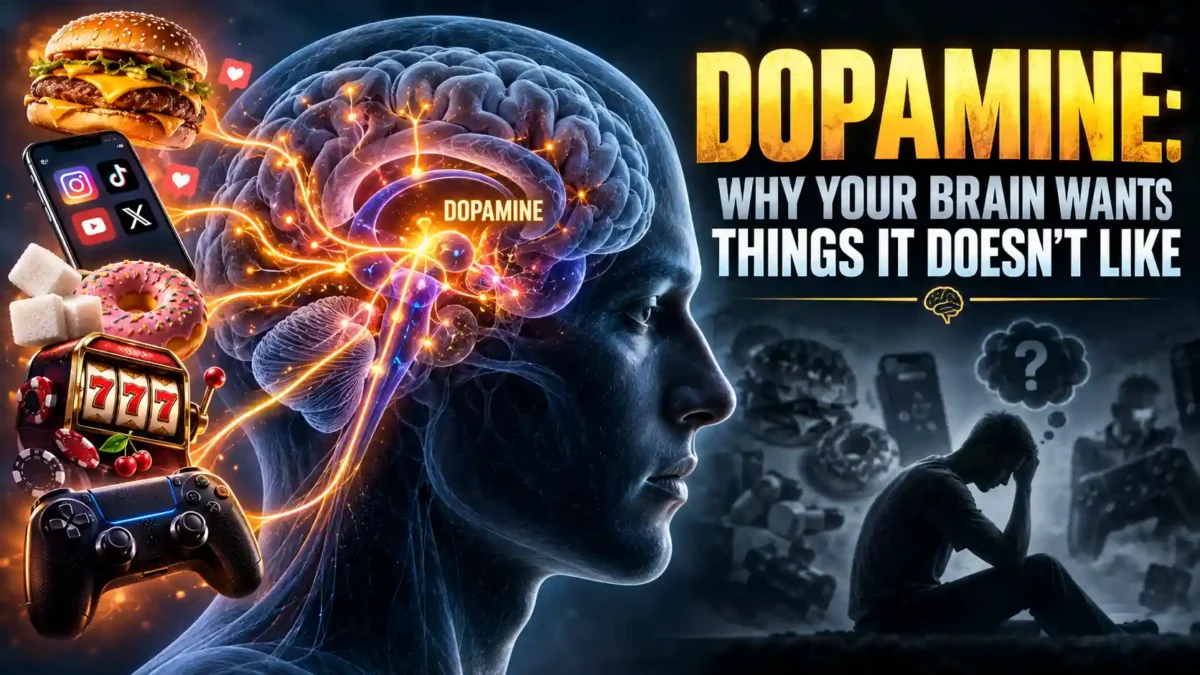
The Wanting Machine: Why Your Brain Can Crave Something It Doesn’t Even Like
Most people carry a confident, wrong idea about dopamine. Ask someone what it does and they’ll say: pleasure. The reward chemical. The thing that makes you feel good. This is not exactly false the way a flat-earth claim is false. It’s more like saying a compass “makes north” — it mistakes the instrument for what the instrument measures.
Here is what dopamine actually does, discovered in a series of experiments that Wolfram Schultz published in Science in 1997 and that has since been cited more than 13,000 times: it signals surprise. Specifically, the difference between what you expected to happen and what actually happened. More reward than predicted? Dopamine neurons fire. Exactly what you expected? Dopamine barely responds. Less than expected? Dopamine drops below its baseline rate, actively suppressing.
The brain is running error-correction software. Dopamine is the delta, not the prize.
What makes this genuinely strange is the corollary: once you’ve learned that a cue predicts a reward, the dopamine burst migrates. In Schultz’s monkey experiments, the animals were trained to associate a light with juice. Early on, the dopamine fired when the juice arrived. As the association became reliable, the dopamine burst shifted back in time — it fired when the light came on, not when the juice arrived. And when the juice appeared exactly as predicted? Almost no dopamine response at all. The signal had migrated entirely from reward to anticipation.
Then the researchers did the revealing thing: they turned on the light, but withheld the juice. At the exact moment the juice should have arrived, the dopamine neurons didn’t just stay quiet. They went below baseline. The system didn’t shrug. It registered the violation.
This is what you are running on. Not a pleasure machine. An anticipation machine, calibrated to the gap between what you expected and what you got, constantly scanning for signals that something better than baseline is coming.
Now hold that framework and walk into a more uncomfortable set of findings, because this is where the science stops being abstract.
In the late 1990s, neuroscientist Kent Berridge and his colleague Terry Robinson were studying rats with severely depleted dopamine systems — animals that, by conventional thinking, should have lost their ability to experience reward. What they found inverted the standard model. The dopamine-depleted rats completely lost their motivation. They would not work for food, nor would they show signs of motivated pursuit. In fact, if food wasn’t placed directly into their mouths, they would starve to death surrounded by it. When the researchers manually placed sugar water into the mouths of these dopamine-depleted rats, the animals did show clear signs of enjoyment. Rats have specific, cross-species facial expressions for pleasure (like licking their paws and rhythmic tongue protrusions). The dopamine-less rats still made these “happy faces”.
Berridge called this the wanting/liking dissociation, and it is the single most important piece of neuroscience for understanding modern life. “Wanting” — the motivated pursuit of something, the craving, the pull — is generated by large, robust mesolimbic dopamine systems. “Liking” — the actual hedonic experience of getting the thing — is mediated by separate, smaller, more fragile neural circuits in specific hotspots within the nucleus accumbens, and it does not depend on dopamine at all.
The architecture is radically asymmetric. Wanting is a massive, durable system. Liking is a small, fragile one. And critically: they can come apart. You can want something intensely and derive almost nothing from getting it. You can want without liking. This is not a glitch. It is a design feature that has become, in the current environment, a serious vulnerability.
The clearest illustration of what happens when this system is pushed to extremes comes from addiction research. With repeated stimulation, the dopamine system’s “wanting” circuits can be sensitized independently of the “liking” circuits. The craving intensifies. The pleasure does not follow. People in the grip of compulsive behavior often describe exactly this: the wanting is enormous, consuming; the satisfaction of getting is almost nothing. They reach for the thing not because it feels good but because not reaching feels worse. The wanting has been amplified beyond any relationship to pleasure. Liking has been left behind.
This is where the everyday version of the story gets uncomfortable.
Scroll. Nothing satisfying. Scroll more. Put the phone down. Feel slightly worse than before you picked it up.
Enjoying this?
Get more deep dives like this one, straight to your inbox.
You probably know this feeling from the inside. What you may not know is the mechanism behind it, which is specific and anatomically measurable.
Chronic exposure to supraphysiological dopamine signals, the kind produced by smartphones, ultra-processed foods, and high-stimulation media triggers a protective neuroadaptation. The brain responds to being repeatedly flooded with unusually strong dopamine signals by reducing the number and sensitivity of its postsynaptic dopamine receptors, particularly the D2 receptors in the striatum. Think of it as the brain turning down the volume on a speaker that’s been cranked too loud for too long. It’s a reasonable protective response. The problem is what happens when the loud noise stops.
Without the high-stimulation input, normal activities that previously generated adequate pleasure now produce a dopamine signal too weak to register against a system that has been calibrated for something much stronger. The result is the specific flatness that characterizes chronic overstimulation: not sadness exactly, but a kind of motivational static. Things that should feel interesting feel gray. Enjoyment that should come easily requires effort. Rest feels like restlessness.
This is not a metaphor or a moral failing. It has a measurable anatomical signature. PET imaging studies have shown that anhedonia and depression are associated with reduced striatal responses to reward, and that D2 receptor binding can remain measurably suppressed for months after heavy stimulation ends. The flat feeling is a physical state.
What chronic overstimulation does, via this mechanism, is functionally redefine what counts as interesting at a neurological level. Boredom is, in part, the subjective experience of dopamine signaling that reality is underperforming relative to expectation. When the expectation has been shifted upward by months of high-stimulation inputs, ordinary life registers as boring almost constantly. Not because life has changed, but because the measuring instrument has been recalibrated. The threshold for what counts as “enough” has moved, and real life can’t clear it.
Here is where the design of the apps you use every day enters the picture, and where the story shifts from natural system to engineered one.
A researcher named Roffarello and Russis catalogued what they called “dark patterns” in digital design: suggestions, auto-play, pull-to-refresh, infinite scrolling, and social investment. These are not emergent side effects of building good software. They are a discrete, nameable taxonomy of engineering decisions made specifically to exploit the anticipation loop that Schultz’s research described.
Infinite scroll is worth looking at closely, because its mechanism is so specific. Reading a chapter, finishing a conversation, reaching the bottom of a list: all of these are completion cues. The nervous system uses them as signals to disengage. Infinite scroll eliminates the completion cue entirely. There is no bottom. The page simply continues. The nervous system never receives the signal that says this is done, you can stop now. By removing the pagination footer, the app removes the natural decision point where a user would otherwise ask themselves whether to stay or leave. The question is never asked. You keep scrolling not because you decided to but because nothing told you to stop.
Pull-to-refresh is a Skinner lever dressed as a design flourish. The slight resistance of pulling down, the spinning indicator, the unpredictable payload of new content or nothing: this is a variable ratio reinforcement schedule, the same schedule that makes slot machines behaviorally powerful and that generates the most persistent, extinction-resistant behavior patterns known to learning science. The unpredictability is not a bug. It is the feature. If the refresh always returned new content, it would lose much of its pull. The not-knowing is what keeps you pulling.
Notification batching works through the same prediction error logic that Schultz identified. Each notification is a light that might precede juice. A 2022 study published in PLOS ONE found that notification-driven phone use produced shorter but more frequent behavioral sequences — unlock, browse, lock — and that notification recipients showed significantly higher compulsive phone use scores than those who used their phones intentionally. The light keeps flashing. The wanting keeps activating. The liking, if it ever arrives, is brief and insufficient and already receding by the time the phone goes back in the pocket.
The food parallel is worth making explicit, with a necessary precision about what the evidence actually shows.
Animal and human studies have demonstrated that chronic excessive consumption of ultra-processed food can produce behavioral signatures characteristic of addiction: bingeing, craving, tolerance, and withdrawal, accompanied by dopaminergic alterations within the mesolimbic reward circuitry. Neuroimaging and molecular studies show that chronic overconsumption of ultra-processed foods alters dopaminergic tone, disrupts prefrontal control, and activates stress pathways. Structurally, the pathway being hijacked is the same one that drugs exploit.
But precision matters here. A 2025 neuroimaging study published in Cell Metabolism, looking at young, healthy adults, found that consuming an ultra-processed milkshake did not, on average, produce a significant dopamine release in the striatum. The safer and more accurate claim is this: it is chronic overconsumption, accumulated over time, that reshapes the dopamine system — not a single processed meal producing a measurable spike. The behavioral evidence for long-term neuroadaptation is solid. The acute-spike framing is not. The mechanism is slow erosion, not sudden flood.
Which brings everything back to the asymmetry, because this is the piece of information that almost nobody has been given, and it is the most practically important thing in this article.
Getting into a state of chronic dopamine suppression is fast. Weeks of heavy smartphone use, ultra-processed food, and high-stimulation media is enough to measurably shift baseline receptor sensitivity downward. Getting out is slow. Imaging studies show that D2 receptor binding can remain suppressed for three to four months after heavy stimulation ends, with full recovery in some cases taking closer to a year. And the subjective recovery lags even further behind the physiological one: brain scans can show dopamine receptor levels beginning to climb back toward normal within weeks, while the felt sense of pleasure from ordinary life may remain flat for months after that.
This asymmetry is never in the terms and conditions. It is never mentioned in the app store description or on the packaging. You can shift the baseline down in weeks and spend the better part of a year recovering it. That is not a metaphor for how bad social media is. It is the actual shape of the neurological terrain.
A 2025 review published in the medical journal Cureus introduced a clinical framing for this state: “digital anhedonia,” defined as the diminished ability to find pleasure in real-world experiences after prolonged digital saturation. The paper’s authors argued that it may be the first affective disorder of the attention economy, born not of intrinsic psychopathology but of deliberate environmental design. They noted it is rarely screened for, often misdiagnosed, and nearly always undertreated.
Cureus is a peer-reviewed open-access journal with variable editorial rigor, and this review should not be read as equivalent to a finding in Nature or Cell. But the clinical construct it names is useful regardless of the journal’s prestige, because it gives language to something that is genuinely hard to describe from the inside: the specific experience of a person whose hedonic baseline has been shifted by their environment rather than by any identifiable illness.
So what actually works? This is the part where almost everything you have read on this subject goes wrong, and it goes wrong in a specific direction: it moralizes when it should mechanize.
The 24-hour dopamine detox — avoid your phone for a day, feel refreshed, return to your regular inputs — produces a real but temporary experiential shift. You feel better because you are less immediately activated. You do not feel better because receptor density has changed. Return to the same inputs and the baseline reasserts itself within days, because nothing about the underlying receptor landscape has been altered. The problem was never the dopamine. Dopamine does not actually decrease when you avoid stimulating activities; it is involved in basic functions including movement and cognition that continue regardless. Harvard Health has made exactly this point: a true neurochemical dopamine fast cannot happen.
What does change, over weeks and months of reduced supraphysiological stimulation, is receptor sensitivity. The D2 receptors in the striatum, no longer subject to the chronic ceiling pressure that was forcing their downregulation, begin to recover toward their baseline density and responsiveness. The practices that actually work do so not because they are virtuous or disciplined or productive, but because they create the neurological conditions for this recovery to occur. The mechanism is biological. The timeline is biological. The moral valence is irrelevant to the outcome.
This is where boredom becomes interesting, because the popular framing has it exactly backward. Boredom is widely treated as a problem to be solved, a gap to be filled, a failure of engagement. But neurologically, boredom is the subjective experience of a dopamine system signaling that the current environment is not meeting its recalibrated, inflated predictions. And that experience, uncomfortable as it is, is precisely the condition the system needs in order to recalibrate. The absence of anticipatory stimulation is not a bug in the recovery process. It is the recovery process. Sitting with boredom — not filling it, not escaping it, not optimizing it away — is the specific condition under which receptor sensitivity begins to recover toward normal.
Liked where this went?
Subscribe and never miss the next rabbit hole.
Boredom is not a character flaw. It is the medicine. The discomfort of it is the system doing the work.
This reframe matters because the alternative, the relentless engineering-away of boredom that modern apps are specifically designed to achieve, is precisely what prevents recovery. Every pull-to-refresh that fills the quiet moment, every auto-played video that covers the gap between one thing and the next, every notification that interrupts a stretch of low-stimulation time: these are not neutral conveniences. They are, mechanistically, interventions that interrupt the recovery window. The wanting machine stays calibrated to the high-stimulation environment because it is never given the low-stimulation environment long enough to adjust.
What this means practically is that the practices most likely to help are not the dramatic ones. A 30-day phone detox documented on social media is less useful than the quiet, undramatic accumulation of low-stimulation time over months. Long walks without headphones. Meals without screens. Stretches of genuine unscheduled time that are allowed to feel boring rather than immediately filled. Not because these things are wholesome or virtuous, but because they are the specific inputs the dopamine system needs to recover toward a baseline where ordinary life can register as adequate again.
The goal is not to feel nothing. The goal is to recalibrate the instrument so that something registers at all.
Wolfram Schultz’s prediction error equation, the same mathematics that evolution built into the mammalian brain and that computer scientists independently derived for machine learning, says something quietly devastating about the current moment: a system optimized to detect and pursue positive surprises will be most activated, most alive, most engaged, in an environment of genuine uncertainty and genuine reward. Not in an environment of engineered unpredictability with no payoff. Not in a stream of variable-ratio reinforcement schedules designed by product teams to maximize session length. The monkey reaching for the juice is in a relationship with something real. The monkey flinching at a light that never resolves into juice is in a trap.
The wanting never stops because the cue never resolves. That is the design. And the wanting, unmoored from any genuine liking, does not feel like pleasure. It feels like restlessness. It feels like the specific modern malaise that is hard to name because it does not look like suffering from the outside: functional, busy, connected, and somehow flat.
The neurological diagnosis is not a judgment. The system is doing exactly what a healthy dopamine system does when its calibration has been systematically shifted by its environment. The instrument is working. The environment it is measuring has been engineered to break it.
That is worth knowing. The knowing does not fix anything on its own, but it changes what you are dealing with. Not a weakness. Not a distraction problem. Not a failure of willpower. A measurement instrument that has been recalibrated by its environment, slowly, over time, in a direction that serves someone else’s interests rather than yours. And an instrument that, given the right conditions and enough time, can find its way back.



Leave a Reply